This post is very much inspired by and in direct response to Ben Kuhn’s short post think real hard. Kuhn introduces and briefly interrogates a hilariously reductive problem-solving technique commonly attributed to Richard Feynman:
- Write down the problem.
- Think real hard.
- Write down the solution.
When I read this, it makes me think of this image:
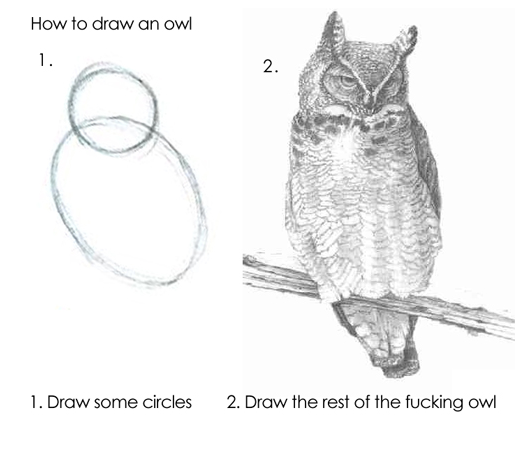
At first glance, this advice is not terribly useful, and likely the last thing that people want to hear when working on hard problems: “Have you tried thinking about it yet?”
And yet this framing has stuck with me for a long time. It’s almost kind of freeing to acknowledge that hard problems require thinking really hard, and that if you haven’t solved it yet, that just means that you haven’t thought about it enough. Feynman doesn’t offer any quick tricks, shortcuts, or fire sales on problem-solving — just the recognition that to bear the fruits you must labor.
I also want to draw attention to (1) and (3), because much like the ovals in the owl drawing, they provide structure for the substance of the matter: “hard thought.” There are many quotes I could draw on here: “a problem well put is half solved” (John Dewey), “to teach is to learn twice” (Joseph Joubert), and my personal favorite: “if I had an hour to solve a problem I’d spend 55 minutes thinking about the problem and 5 minutes thinking about solution” (debatably said by Albert Einstein). I’ve often found in my work that clearly defining problems is much more important than the techniques I use to solve them — whether for ML, bio, or software. In ML, defining a problem often means your evals and data, something which I have always benefited from spending more time on. As Andrej Karpathy put it, step 1 is to “become one with the data.”
So, I broadly agree with Feynman, Kuhn, Dewey, Joubert, Einstein, and Karpathy. Why, then, do I write this post?
The future of work is rapidly changing. White-collar workers are relying more and more heavily on AI, both to automate boring processes, but also to automate thinking. I am no stranger to this: I work at a fast-moving startup where we rely heavily on AI to code. AI coding is very impressive and inarguably multiplies the output of our team.
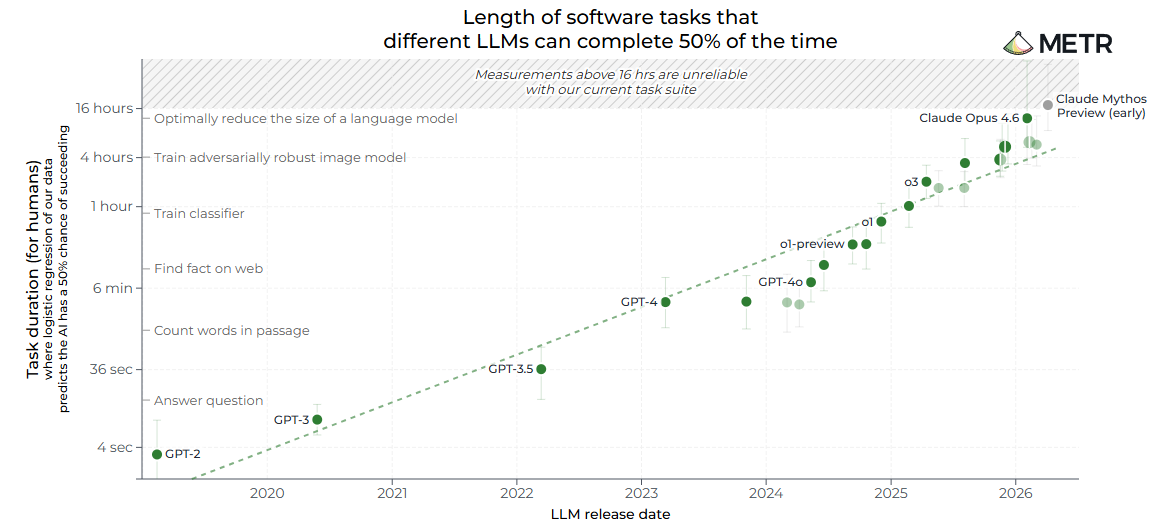 I don’t love this plot but it’s the best one I could find without making one myself (source).
So we’ve been handed this incredible tool and told to go crazy — but the natural question with a new tool is how to use it. Yes, there are things which AI can do much faster than me, but which things still require me to write the problem, think hard, and write the solution? I think honing this skill is one of the most important things to do if you work with AI. And I’m not great at it! This skill is very very hard to learn. My rough heuristic is this:
The more important a problem is, the more you should think about it.
It sounds stupid and lighthearted in the same way Feynman’s problem-solving advice does. But I think it’s incredibly important for doing good work. The worst work I’ve done is when I tried to use AI to automate important things, and the best work I’ve done is when I’ve decomposed a problem into the parts I have to think really hard about and the parts I do not. Writing the problem down, talking with stakeholders, and deeply understanding the form of a solution is extremely useful.
I guess that’s all I wanted to say. I think it’s become easier than ever to lose the art of thinking hard, and that really saddens me. But in another way, now is the most opportune time to set yourself apart as a great problem-solver by thinking really hard.